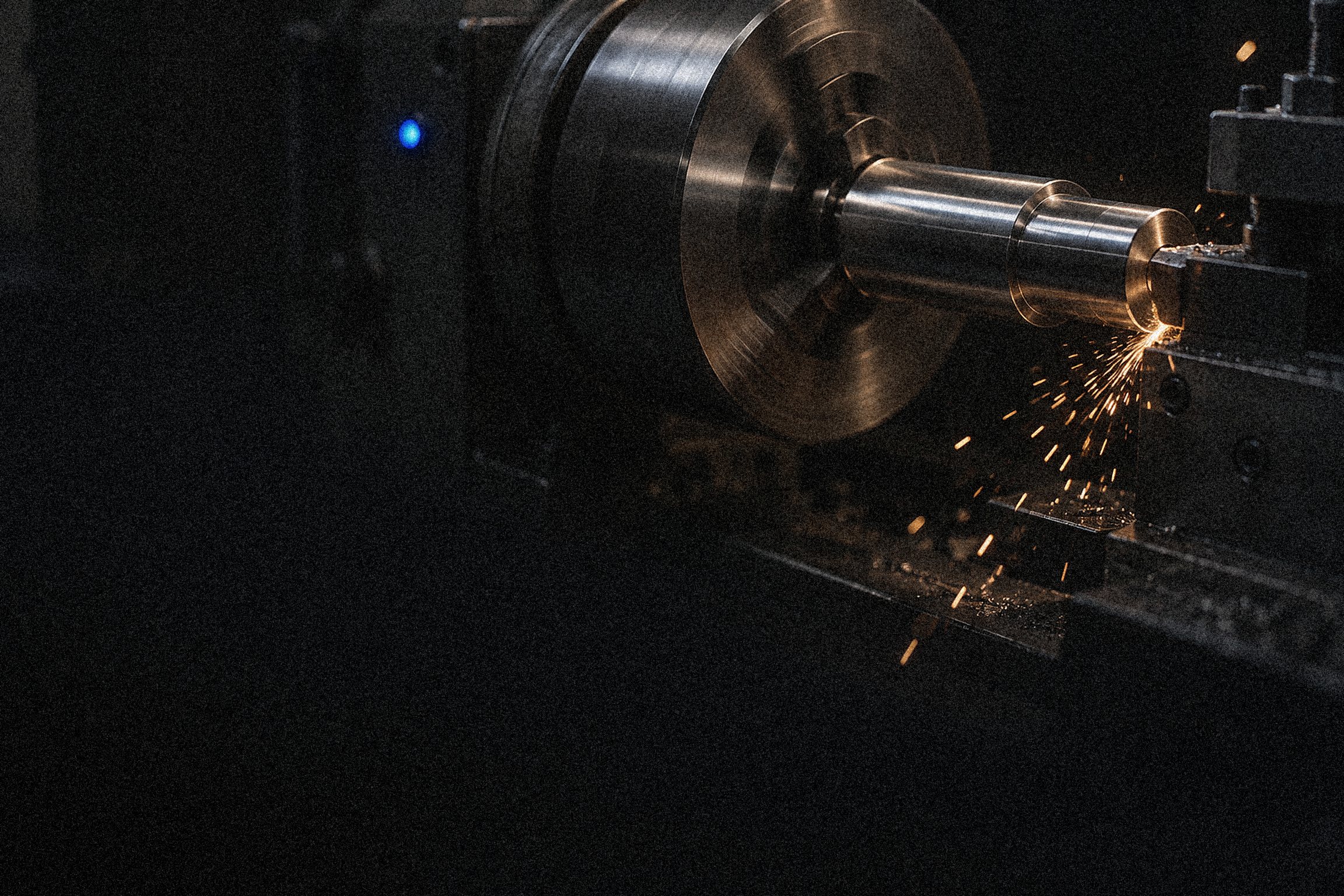
One of Sphere's projects is a predictive analytics model that forecasts failures of lathe equipment for a major automaker. The brief is short, but behind it lies one of the most practical areas of machine learning in manufacturing: learning to see in the data that a machine is about to fail before it actually does.
In this article we look at how predictive analytics for equipment works, what makes such projects hard at a large plant, what a system like this usually needs to do, and how we approach it through our stages. This is not a retelling of the project's technical documentation but a breakdown of this type of problem, useful for anyone thinking about failure prediction on their own shop floor.
What predictive analytics for equipment is and why a plant needs it
There are three basic approaches to maintaining equipment in manufacturing:
- Reactive: fix it when it breaks. Cheap until the first serious breakdown, and after that it means line downtime, rush-ordered spare parts and a missed production plan.
- Preventive: service on a schedule, every N hours or cycles. More reliable, but some of the work is wasted, and some failures still happen between scheduled windows.
- Predictive: service when the data shows a component has started to degrade. That is predictive maintenance.
Predictive analytics for equipment is the analytical layer that makes the third approach possible. The model looks at sensor readings, machine logs and repair history and estimates the risk of failure over the near horizon: a shift, a day, a week. The maintenance team gets not "the machine broke," but "this machine's spindle assembly is showing rising failure risk; worth checking in the next window."
For lathe equipment this is especially relevant. Machines work in sequence with neighboring operations, and a sudden stop of one often holds up the whole area. Wear in bearings and tooling, and problems with drives and hydraulics, usually develop gradually, which means they leave a trace in the data before they become a breakdown.
What makes failure prediction hard at a large plant
From the outside the task looks like "take the data and train a model." In practice, most of the work happens around the model.
The data is scattered and inconsistent
A large plant runs a fleet of machines from different generations and manufacturers. Some write detailed telemetry, others almost nothing. Repair data often lives separately from machine data: in a maintenance management system, in spreadsheets, in paper logs. Before predicting anything, all of it has to be merged into one picture and tied to the same equipment units and points in time.
Failures are rare, which is good for the plant but bad for the model
Failures are rare events. Thousands of hours of normal operation produce only a handful of breakdowns, and they differ in nature. A model trained naively will easily learn to say "everything's fine" and will technically be right almost all the time. In these projects it is crucial to frame the problem correctly: what exactly counts as a failure, what horizon we predict for, and how we evaluate quality given how rare the events are.
The cost of errors is asymmetric
A missed failure and a false alarm cost different amounts. If the model errs too often toward alarms, supervisors quickly stop trusting it. If it misses failures, it loses its point. The balance between these errors is a business decision to be made together with production, not just tuned with a metric.
The model has to live in the process, not in a report
A forecast is useful only when it reaches the right person at the right moment and turns into action: an inspection, a component replacement, a repair moved into a planned window. If the result sits in an analyst's notebook, the project isn't working.
A forecast is useful only when it reaches the right person at the right moment and turns into action.
What a predictive maintenance system usually needs to do
The scope depends on the specific plant, but systems of this class share a typical set of capabilities:
- Data collection and preparation: loading telemetry, machine events and repair and replacement history, cleaning out noise and gaps, synchronizing by time.
- Condition features: indicators that reflect wear are computed from raw signals, such as trends, deviations from normal operation and changes in behavior under load.
- Prediction model: an estimate of the probability of failure or the remaining useful life of a component over a given horizon.
- Explainability: why the model considers a machine at risk, and which indicators have deviated. Without this, it's hard for a supervisor to decide what to inspect.
- An interface for people: a list of equipment with risk levels, a history for each machine, notifications to the people responsible.
- Feedback: whether an alarm was confirmed on inspection. These marks later become new data for retraining.
- Monitoring the model itself: prediction quality changes over time as operating modes, the part mix and the equipment fleet change. This needs to be tracked.
Which of these blocks a particular project needs, and to what extent, is determined at the start.
How we approach these projects: analysis
Our process is the same for websites, apps and services. In an ML project the emphasis shifts, but the logic stays the same: first we understand the business, then we build the solution.
- Analysis. We study the equipment, failures, data and how maintenance is organized.
- Design. We design screens where the forecast is easy to read on the shop floor.
- Development and testing. We build the data pipeline, the model and the integration with the plant's systems.
- Launch and growth. We run a trial period, retrain the model and expand the scope.
During analysis we work out:
- which equipment is in scope and why that equipment, meaning where downtime costs the most;
- which failures happen most often and which cost the most, since those should be predicted first;
- what data actually exists, over what period, how complete it is and how it connects;
- how maintenance currently works: who decides to stop a machine, how repairs are planned, where work is recorded;
- what will count as project success and how to measure it.
The output of this stage is not just a specification but an honest answer to whether there is enough data for the task.
Design: a forecast that's easy to read on the shop floor
In machine learning projects in manufacturing, the interface is often an afterthought, and that's a mistake. The system's users are not data scientists but shift supervisors, mechanics, reliability engineers and area managers. They are short on time, and they need an answer to "what do I do," not a chart with ten lines.
In these projects it's important to think through:
- how to show the risk level so it can't be misread;
- how to explain what the forecast is based on without mathematical jargon;
- how to log the result of an inspection quickly, so feedback doesn't turn into extra paperwork;
- which notifications are needed and for whom, so you don't create a stream of alerts everyone starts ignoring.
We work out the scenarios and screens before development, just as with any other product.
Development and testing: model, data and integration
Custom ML model development runs as several parallel streams of work.
Data preparation and experiments
First, a reproducible data pipeline is built: where everything comes from, how it's cleaned, how features are computed. Then come experiments with different modeling approaches.
Review with experts
It pays to go through the model's forecasts with the maintenance team. If the model flags a machine and the supervisors know why it showed odd readings in that period, for example during a setup or a change in the part mix, that's a reason to improve the data or the features.
Integration
The model is embedded into the plant's systems: it receives data from existing systems and delivers forecasts to where people work with them. This block is often comparable in size to the model itself.
Launch and growth: why you can't "hand over and forget" a model
A predictive model is a living product. The most important part starts after launch:
- Trial operation. Forecasts are compared with reality, feedback is collected from the maintenance team and alarm thresholds are refined.
- Retraining. New data, especially confirmed failures and false alarms, makes the model more accurate.
- Expanding the scope. If the approach works on one type of equipment, it is extended to others, taking their specifics into account.
- Linking to planning. The next step after the forecast is building it into repair planning and spare parts procurement.
We look at a project like this the same way as at any digital product: launch is the beginning of the work, not the end.
A predictive model is a living product: launch is the beginning of the work, not the end.
When predictive analytics makes sense for your plant
Before commissioning a model, it's worth answering a few questions honestly:
- Is sudden equipment downtime expensive for you? If stopping a machine costs almost nothing, the benefit of a forecast will be small.
- Do you have data on equipment operation and repairs going back at least a few years, or are you ready to start collecting it?
- Can the maintenance team act on a forecast: are there service windows, spare parts in stock, authority to stop a machine?
- Are you ready to start with a pilot and measure the result before scaling?
If the answer to most of these is yes, predictive maintenance is usually worth considering. Our other projects across different industries are collected on the portfolio page.
FAQ
How is predictive maintenance different from preventive maintenance?
Preventive maintenance follows a schedule, after a set number of hours or cycles, regardless of the component's condition. Predictive maintenance relies on data: service is scheduled when the model sees signs of degradation. That avoids unnecessary work and makes sudden failures less frequent.
What data do you need to predict equipment failures?
Usually machine telemetry (load, vibration, temperature, current, operating modes), event and error logs, and the history of repairs and component replacements. The key is that operating data and failure data can be linked by equipment and time. The exact set is defined during the analysis stage.
Can you start without sensors on every machine?
You can often start with what's already being collected: machine controller data, logs and repair history. The pilot results show which signals are missing and whether additional sensors are worth installing.
How much does custom ML model development cost?
The cost depends on the state of the data, the number of equipment types, how deeply the model integrates with the plant's systems and whether a user interface is needed. The clearest way to estimate it is to start with analysis and a pilot: after them, the scope of work and the risks are much easier to see.